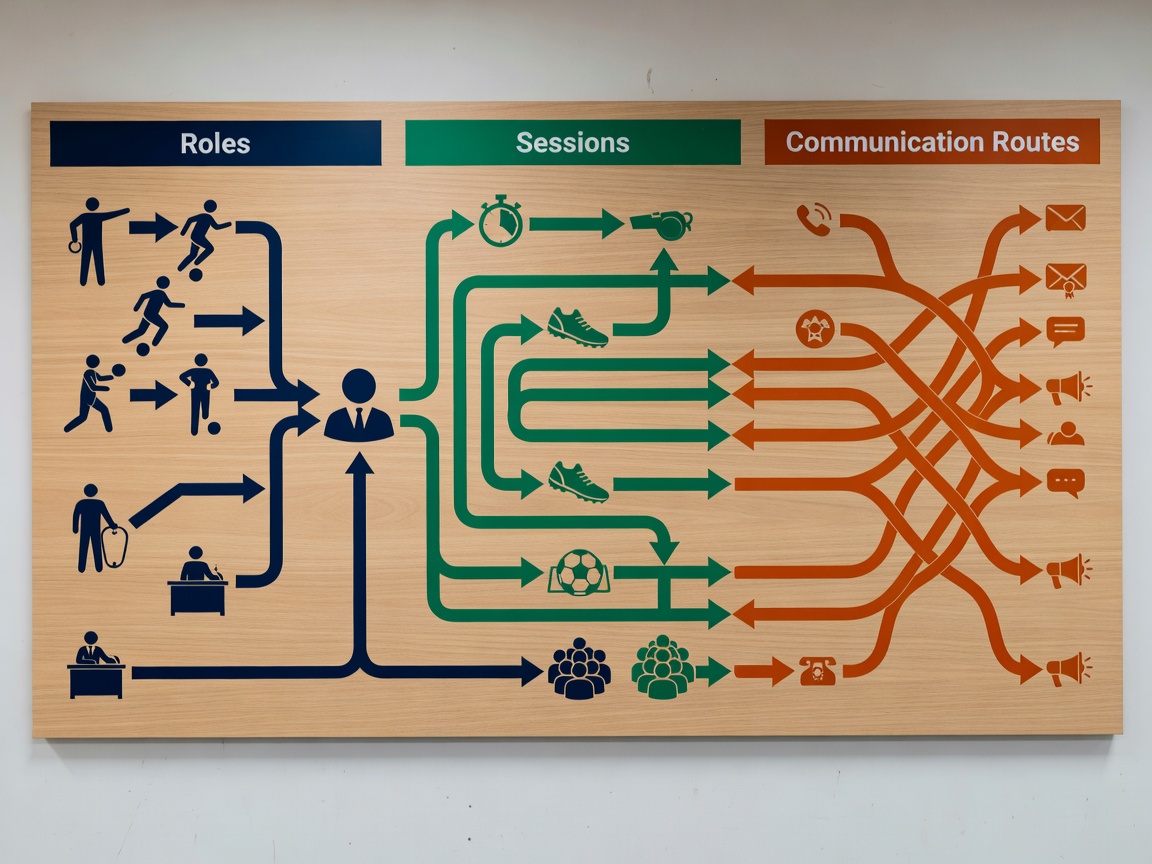
Where do club systems become tangled?
Tangles usually form between responsibilities. A committee approves a programme, a coaching lead allocates staff, volunteers manage attendance and a welfare officer handles concerns. If boundaries remain implied, the same task may be done twice or not at all.
Start by following a few real activities from beginning to end: adding a new session, recruiting a coach, cancelling because a venue closes, responding to an incident and moving a participant between groups. Write down who decides, who acts, who must be consulted and where the record lives. This exposes gaps more quickly than drawing a grand organisation chart.
Volunteer-led clubs need proportionate arrangements. Complexity that might be manageable for paid staff can exhaust a small committee. The aim is not to imitate a national governing body. It is to meet legal and governing-body requirements while giving local people a clear way to work.
How should coaching roles be defined?
A role description should cover purpose, main responsibilities, authority, accountability and required checks or qualifications. It should explain whether a coach can alter group sizes, approve assistants, communicate directly with parents or carers, and make spending decisions. The answers vary, but silence is rarely helpful.
Distinguish technical leadership from line management and safeguarding responsibility. One person may hold several roles, especially in a small club, yet the responsibilities should still be named. The club welfare officer needs an appropriate route to leadership and should not be expected to investigate every concern personally.
Cover arrangements matter too. If the head coach is absent, who confirms that the substitute has the right information, competence and safeguarding clearance? Last-minute kindness is not a deployment policy.
Which records are worth keeping?
Keep records because they support a defined purpose: safe delivery, participant communication, financial accountability, governing-body requirements or organisational learning. Attendance, emergency details, consent, coach checks, qualifications and incident records may all be necessary, but they should have appropriate access and retention rules.
Avoid scattering personal information across private messaging accounts, paper notebooks and several spreadsheets. Choose an authorised location, restrict access and provide a way to correct errors. Under the UK GDPR and Data Protection Act 2018, organisations need a lawful basis and should collect only data necessary for the purpose.
What makes communication reliable?
Match the channel to the message. Routine scheduling can use a shared calendar or approved group communication tool. A safeguarding concern needs the designated reporting route. A complex change in coaching responsibility may need a conversation followed by a written record.
Participants and families should know where authoritative information appears. If cancellations arrive through several informal channels, somebody will inevitably find the one channel nobody checked. Communication standards should also cover conduct, privacy and contact with children, following the club’s safeguarding policy and governing-body guidance.
Good internal communication includes feedback upwards. Coaches need a route to report equipment, workload, inclusion or welfare issues without waiting for an annual meeting. Leaders then need to close the loop by explaining what happened next, including when no immediate change is possible.
How much governance is enough?
Governance gives decisions legitimacy and traceability. The board or committee should reserve major decisions, delegate operational work and receive information proportionate to its oversight role. Sport England and UK Sport publish A Code for Sports Governance, which is especially relevant to funded organisations and offers broader prompts around accountability, integrity and diversity.
A community club can borrow the principles without importing every layer. Record material decisions, conflicts of interest and agreed actions. Review whether delegated authority remains suitable. Make sure safeguarding can reach decision-makers. Keep policies consistent with what the club can genuinely do.
Risk registers can help when they lead to action. A list of hazards that nobody owns is simply a gloomy archive. Focus on plausible issues, existing controls, further action and responsibility. Urgent safety and safeguarding concerns need direct escalation rather than waiting for the next routine review.
How do systems improve without constant upheaval?
Choose one recurring friction, understand its causes and make the smallest change that addresses them. Test the change with the people doing the work. A revised session-allocation process might need a single named coordinator and a cut-off for changes, not an elaborate software purchase.
Review consequences beyond speed. A simpler booking process might weaken safeguarding checks; a centralised decision might remove useful coach judgement. Improvement always involves trade-offs, so name them. Then document the settled approach, explain it and give it enough time to work before redesigning it again.
Useful operational questions
- Who owns each recurring decision?
- What can coaches adapt without approval?
- Where is the authoritative record?
- How are urgent concerns escalated?
- Who covers an absent role?
- Which process creates effort without reducing risk?